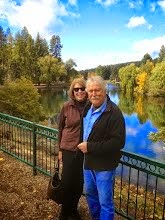
First stop was the coast: lighthouses and bobbing boats and foggy fishing harbors and ferries to nearby islands. The water world of Washington is magnificent and bountiful. We bought fresh albacore off a boat in Westport and Quilcene oysters for dinner that night. In the National Historic Register town of Port Townsend, we camped at the water's edge, watching ferries and yachts ply the calm waters just outside our door.
One foggy morning, we got an early low-tide start on a trek to the distant Dungeness lighthouse, perched at the tip of a curving spit of sand on the invisible horizon. It was my just-turning-70 right of passage and a 12-mile test of my often problematic knees.
Stopping along the way to photograph hot pink seaweed, darting shore birds and giant driftwood, we took our time, then spent an hour exploring the historic lighthouse and keeper's home, chatting with the friendly volunteers who manned the site.
The sea didn't wait for us. As the incoming tide covered ever more of the hard-packed sand we'd come out on, the hike back to camp became a real slog through soft sand, rocks and kelp. There's only one way in and out and we were grateful not to be those hikers who've been caught on extreme high tides, forced to cover the miles crawling atop stacked driftwood at the high tide mark.
The sun shone on the sea stacks in the picturesque town of La Push, where we bought smoked salmon from a young Makah fisherman who sold it at his backdoor in the tribal subdivision as a blond nameless cat wrapped herself around our ankles. Earlier, we'd visited the Makah natural history museum, an incredible display of native artifacts buried under a coastal mudslide and unearthed mostly intact, a Pacific northwest version of Pompeii.
The fog rolled in like meringue, nourishing the trees and undergrowth and thick emerald mosses. A visit to a big cedar felt like a visit to the Hobbit world, the giant's gnarled and twisted roots and sister trees making a cozy home for a forest elf. Heading to yet an even bigger tree -- the reputed largest cedar in the world -- we were stunned at the clear-cut hillsides, deforested of all life and a jarring contrast to the lush green stillness of the living forest.
A drive over bumpy logging roads took us to the "biggest cedar," spared by loggers who were impressed by its massive size. Saw marks at the base of this 178-foot specimen indicated it was saved at the last minute. But now, deprived of the communal shelter of neighboring trees, this monarch stood exposed to the elements, without bark and showing little green at the top -- a gray ghost nearing the end of its life.
A herd of Roosevelt elk raised ears in alarm before bolting into the forest as we headed toward the Hoh Rain Forest in Olympic National Park, one of planet's best examples of a temperate rainforest, receiving up to 14 feet of rain a year. Moss grew thickly atop a phone booth at the entrance to this World Heritage site, an indication of things to come. Breathing in the cool, fragrant air, we hiked along the misty Hall of Mosses trail, enveloped in emerald stillness, feeling we should speak in whispers in the midst of such grandeur. If ever there was a place to become a tree-hugger, this was it.
iPhone photo gallery at:http://www.photoshow.com/watch/fr3Ka5zY
Sunday, October 6, 2013
Thursday, September 12, 2013
Keeping It Weird
We never realized just what an interesting place this is.
It’s illegal in Oregon to:
--Pump your own gas;
--Feed canned corn to fish;
--Strap a child seat occupied by a baby to the top of your car and drive down the highway.
Our "Secrets of Portlandia" walking tour guide vouches for these and other fascinating snippets of local trivia going back to the city’s earliest days.
Among the few explorers who arrived to this location in the 1800s, two in particular thought it a practical location for a town. One hailed from Portland, Maine; the other from Boston. Each wanted to name the new town after his East Coast home, but in the end, the Maine resident was more persuasive.
The site of the new city was heavily wooded, save for a clearing that is now Pioneer Square. Cutting down massive trees to build a city was one thing; but removing the stumps a far more difficult task, so city founders left them rooted in place, giving rise to the name "Stumptown," a nickname that endures today.
Early Portland was a rough-and-ready place where men outnumbered women six to one. When two brave women answered a call for teachers at the newly-built school, they were greeted by dozens of randy lumberjacks running eagerly toward their ship, a sight that drove the terrified women back onboard, never to re-emerge.
Portland today is a young city, heavily pierced and tattooed, welcoming hair of all hues and residents of all genders. Residents are unfailingly cheerful, even chipper, with servers and shop clerks greeting customers like friends.
Women own 50% of the businesses and there is a feminist bookstore where parents can purchase fairy tales rewritten so the princess is the heroine who comes to the rescue. Seniors can ride every form of public transit all day for $2 with a ticket stamped "honored citizen." Dogs are highly respected beings, with their own block parties, Halloween bash and Santa Paws party.
The city boasts both the nation’s largest city park – Forest Park at 5,000 acres – and the world’s smallest: tiny Leprechaun Park in the middle of a street, no larger than the lid of a garbage can. Unlike other cities which post "Keep Out" signs, Portland’s been known to design public fountains to accommodate both children and adults who might wish to take a dip on a hot summer day.
The massive statue of Portlandia holding her trident -- a copper repousse statue second in size only to the Statue of Liberty -- is not a city landmark, but instead is barely visible and scarcely known to most city residents. The sculptor who created it wants to keep it that way.
Portland was the first city in the U.S. to draft a climate change action plan, reducing its carbon footprint by 12% during the last two decades, a period when the nation’s rose by the same percentage. Solar-powered parking meters and compacting trash cans are found on city streets, and electric car charging stations are provided free of charge.
The city is green in all respects, with tree-lined streets, verdant parks and shady neighborhoods of shingled bungalows. Farmer’s markets are well-established, organic produce plentiful. Twenty-five percent of commuters ride bikes to work, a figure expected to climb to 33%. And yet, a Californian is struck by the number of people who smoke cigarettes.
Happy hour is revered, sometimes starting as early as 2 p.m. and offering foods such as truffle fries and water buffalo burgers for $4 and artisan cocktails with intriguing ingredients like cucumber-infused gin and smoked ice cubes for $5. Residents of Portland have long enjoyed imbibing and early pubs had floating bars to allow regulars to paddle by for a pint when the mighty Columbia river flooded the streets.
And beer? Portland is second only to Belgium and the Czech Republic in the number of micro-breweries relative to the population. My favorite brew was Mcmenamins Pomona’s Blush, a fruity ale flavored with 126 pounds of apricots. One carbon-neutral brewery has a bike bar with parking for 60 bicycles.
Quirky Portland is deemed such a cool city that its population has mushroomed like a northwest forest after the first autumn rain. Jobs, however, have not kept pace and the city’s unemployment rate is second only to Detroit’s. So strong is its siren song that college graduates move to Portland to retire at the age of 23.
Lack of employment opportunities and a lively entrepreneurial spirit have fostered the proliferation of the city’s latest draw for food enthusiasts: the food carts. Miniscule and mobile, the popular food shacks have grown in number from 100 to over 700 during the economic recession of recent years. Situated in pods on the perimeter of parking lots where they pay monthly rent and are subject to unannounced health inspections, the carts operate in a multinational harmony that would be the envy of the UN: Egyptian shawarma abuts Czech schnitzel; Vietnamese pho is a neighbor to Mexican burritos. The food is delicious, fast and inexpensive, offering both entrepreneur and customer an affordable alternative to a bricks and mortar restaurant.
For their part, Portland’s restaurants increasingly attract big-name chefs from across the nation, making Stumptown an exciting foodie destination. Winemakers are moving in from the Willamette Valley to set up wineries downtown.
It was this entrepreneurial spirit that created one of the city’s quirkier attractions. Weary of working until 2 a.m. closing time each night, two local bartenders were drifting down the river in fat inner tubes – a popular summer pastime – and pondering a new profession. Noting its resemblance to the pastry, one of them looked at his inner tube and said, "That’s it! Doughnuts!"
Thus was born Voodoo Doughnuts, a wacky city institution that draws Food Network celebrity chefs and long lines of customers for such creations as maple-bacon bars, voodoo dolls filled with raspberry jelly "blood" and doughnuts shaped liked the nether regions of the male anatomy. With its bawdy slogans and off-the-wall creations, Voodoo captures the spirit of Portland and brings in $8 million a year.
Waiting in line for Voodoo, a visitor can glance across the street at a sign on the wall that says it all: Keep Portland Weird.
Portland photos are here: https://picasaweb.google.com/happytwo.mcwilliams/Portlandia?authuser=0&authkey=Gv1sRgCLmL6MfwmeyVfQ&feat=directlink
Click on first photo to initiate slide show.
It’s illegal in Oregon to:
--Pump your own gas;
--Feed canned corn to fish;
--Strap a child seat occupied by a baby to the top of your car and drive down the highway.
Our "Secrets of Portlandia" walking tour guide vouches for these and other fascinating snippets of local trivia going back to the city’s earliest days.
Among the few explorers who arrived to this location in the 1800s, two in particular thought it a practical location for a town. One hailed from Portland, Maine; the other from Boston. Each wanted to name the new town after his East Coast home, but in the end, the Maine resident was more persuasive.
The site of the new city was heavily wooded, save for a clearing that is now Pioneer Square. Cutting down massive trees to build a city was one thing; but removing the stumps a far more difficult task, so city founders left them rooted in place, giving rise to the name "Stumptown," a nickname that endures today.
Early Portland was a rough-and-ready place where men outnumbered women six to one. When two brave women answered a call for teachers at the newly-built school, they were greeted by dozens of randy lumberjacks running eagerly toward their ship, a sight that drove the terrified women back onboard, never to re-emerge.
Portland today is a young city, heavily pierced and tattooed, welcoming hair of all hues and residents of all genders. Residents are unfailingly cheerful, even chipper, with servers and shop clerks greeting customers like friends.
Women own 50% of the businesses and there is a feminist bookstore where parents can purchase fairy tales rewritten so the princess is the heroine who comes to the rescue. Seniors can ride every form of public transit all day for $2 with a ticket stamped "honored citizen." Dogs are highly respected beings, with their own block parties, Halloween bash and Santa Paws party.
The city boasts both the nation’s largest city park – Forest Park at 5,000 acres – and the world’s smallest: tiny Leprechaun Park in the middle of a street, no larger than the lid of a garbage can. Unlike other cities which post "Keep Out" signs, Portland’s been known to design public fountains to accommodate both children and adults who might wish to take a dip on a hot summer day.
The massive statue of Portlandia holding her trident -- a copper repousse statue second in size only to the Statue of Liberty -- is not a city landmark, but instead is barely visible and scarcely known to most city residents. The sculptor who created it wants to keep it that way.
Portland was the first city in the U.S. to draft a climate change action plan, reducing its carbon footprint by 12% during the last two decades, a period when the nation’s rose by the same percentage. Solar-powered parking meters and compacting trash cans are found on city streets, and electric car charging stations are provided free of charge.
The city is green in all respects, with tree-lined streets, verdant parks and shady neighborhoods of shingled bungalows. Farmer’s markets are well-established, organic produce plentiful. Twenty-five percent of commuters ride bikes to work, a figure expected to climb to 33%. And yet, a Californian is struck by the number of people who smoke cigarettes.
Happy hour is revered, sometimes starting as early as 2 p.m. and offering foods such as truffle fries and water buffalo burgers for $4 and artisan cocktails with intriguing ingredients like cucumber-infused gin and smoked ice cubes for $5. Residents of Portland have long enjoyed imbibing and early pubs had floating bars to allow regulars to paddle by for a pint when the mighty Columbia river flooded the streets.
And beer? Portland is second only to Belgium and the Czech Republic in the number of micro-breweries relative to the population. My favorite brew was Mcmenamins Pomona’s Blush, a fruity ale flavored with 126 pounds of apricots. One carbon-neutral brewery has a bike bar with parking for 60 bicycles.
Quirky Portland is deemed such a cool city that its population has mushroomed like a northwest forest after the first autumn rain. Jobs, however, have not kept pace and the city’s unemployment rate is second only to Detroit’s. So strong is its siren song that college graduates move to Portland to retire at the age of 23.
Lack of employment opportunities and a lively entrepreneurial spirit have fostered the proliferation of the city’s latest draw for food enthusiasts: the food carts. Miniscule and mobile, the popular food shacks have grown in number from 100 to over 700 during the economic recession of recent years. Situated in pods on the perimeter of parking lots where they pay monthly rent and are subject to unannounced health inspections, the carts operate in a multinational harmony that would be the envy of the UN: Egyptian shawarma abuts Czech schnitzel; Vietnamese pho is a neighbor to Mexican burritos. The food is delicious, fast and inexpensive, offering both entrepreneur and customer an affordable alternative to a bricks and mortar restaurant.
For their part, Portland’s restaurants increasingly attract big-name chefs from across the nation, making Stumptown an exciting foodie destination. Winemakers are moving in from the Willamette Valley to set up wineries downtown.
It was this entrepreneurial spirit that created one of the city’s quirkier attractions. Weary of working until 2 a.m. closing time each night, two local bartenders were drifting down the river in fat inner tubes – a popular summer pastime – and pondering a new profession. Noting its resemblance to the pastry, one of them looked at his inner tube and said, "That’s it! Doughnuts!"
Thus was born Voodoo Doughnuts, a wacky city institution that draws Food Network celebrity chefs and long lines of customers for such creations as maple-bacon bars, voodoo dolls filled with raspberry jelly "blood" and doughnuts shaped liked the nether regions of the male anatomy. With its bawdy slogans and off-the-wall creations, Voodoo captures the spirit of Portland and brings in $8 million a year.
Waiting in line for Voodoo, a visitor can glance across the street at a sign on the wall that says it all: Keep Portland Weird.
Portland photos are here: https://picasaweb.google.com/happytwo.mcwilliams/Portlandia?authuser=0&authkey=Gv1sRgCLmL6MfwmeyVfQ&feat=directlink
Click on first photo to initiate slide show.
Wednesday, June 6, 2012
Wild Kingdom
Terry compares it to fishing, and it’s the element of surprise, and serendipity, that keep it interesting. With over 2.2 million acres of heavily wooded territory ranging to nearly 9,000 feet in elevation, it’s a miracle that we humans, driving along the road that lassos the park in a figure 8, ever see anything at all.
The best clues to the views are the traffic jams with rangers that indicate trophy animals: wolves and bears. But a moose, uncommon in Yellowstone, created a jam, as do most any animals seen for the first time by newly-arrived visitors. On several occasions, we’ve been the first to spot a bear, quickly creating our own roadblock. The sightings we’re all here for are fleeting, and those who arrive even five minutes later may miss it all.
Two days ago, it was a bear jam prompted by a mating black bear pair, a big cinnamon male and a smaller black female. Earlier arrivals had seen a potential rival male amble into the scene of domestic bliss, where he was swiftly chased up a tree by the cinnamon, who swatted him with huge paws as he scrambled skyward.
Seemingly oblivious to the drama she inspired, the female wandered off to graze, while her conflicted mate tried to keep an eye on her and the treed rival as well. The rival shifted his position near the top of the tree, draping legs over limbs like a floppy stuffed animal, knowing he’d be there for a while.
In Lamar Valley, we watched a foolhardy young wolf attempt to take on a bison herd, repeatedly charging toward a little red calf, only to be repelled by a pair of large bulls. Alone and unschooled in the ways of hunting, the hungry black yearling showed remarkable persistence, giving us wolf-watchers a real show before ultimately abandoning the chase.
On a morning that began as sunny, we ascended the grade toward Dunraven Pass, watching the sky darkening from smoky gray to nearly black as we climbed. Rounding a curve, we came upon a lone bison, molting winter coat hanging in tatters from his sides, limping badly on an injured rear leg as he moved toward the summit.
To his left, the snow-covered hill was nearly vertical; on our side of the road was a sheer drop-off. The wind picked up and sleety rain pelted the windshield, while the bison lowered his head and continued his slow journey toward the top, facing traffic and following the white line at the edge of the road. There was no exit from the asphalt and it would be five miles before the terrain afforded any level spots at all.
Knowing this area to be thick with both grizzlies and wolves, I burst into tears. We stayed on the other side of the pass most of the day, and never saw the bison again.
Sometimes the sightings are of smaller animals: a nesting peregrine falcon tucked into a crevice of a cliff, a yellow-bellied marmot sunning on a rock, a raven in a tree with a ground squirrel.
We looked down on the stick nest of an osprey atop a rock above the river, while the bird oddly sat at the edge of the nest, gazing at two tan eggs. A bystander told us she’d seen the eggs dusted with snow days earlier. On our second visit, the osprey was attempting to incubate the eggs, fidgeting and chirping and leaving the nest for short periods of time. On the third day, the nest was unoccupied, eggs baking in the sun.
Among Yellowstone wolves, internecine warfare is diminishing their numbers. The famed Druid pack was lost three years ago, when the pups died of mange and adults were killed or dispersed. A new group began forming in Lamar last year and now is an official pack, with a mating alpha pair and a litter of pups. But the Mollies are changing the landscape, killing most of the neighboring Agate pack and threatening the newly-formed Lamars.
A loose grouping of a dozen or more mostly yearling wolves, the Mollies have no alpha pair and, lacking leadership, roam the area like a rogue teenage gang, killing at will. Last week their victim was a handsome five-year-old Agate male loved by wolf watchers, who’d named him Big Blaze for his striking markings.
None of which concerns the locals. From a Montana great-grandmother to the mild-mannered manager of a park cafeteria, it seems everyone we talk to who lives in the vicinity of Yellowstone wants the wolves gone, blaming them for the decrease in elk, which now number 4,500 in the region.
While biologists acknowledge wolf predation, they also cite recent droughts, which severely decreased forage, and increased hunting as factors in reduced elk numbers. But hunting is big in this neck of the woods and locals want elk bountiful so they can kill them themselves.
As always, humans tip the balance of nature. Wolves were exterminated in the early 20th century and the elk population exploded beyond the region’s ability to feed it. Wolves were reintroduced in 1995, and a natural balance returned, benefiting even local trout. As streamside vegetation returned, so did the insects which feed the trout.
Everything’s got to eat. Grizzlies take many elk calves. Everything eats ground squirrels, from grizzlies to coyotes, foxes, weasels, badgers and birds of prey, which keeps their staggering numbers under control. Otters eat the protected cutthroat trout, but so do the big introduced lake trout, which the Park Service is trying to control. And so it goes.
And we humans come from all parts of the planet to watch this diorama unfold, to know that here, at least in Yellowstone, mostly removed from cell service and wifi, a place exists that is truly wild.
For pictures: (click on first photo to initiate slide show)
https://picasaweb.google.com/lh/sredir?uname=happytwo.mcwilliams&target=ALBUM&id=5750392329709065425&authkey=Gv1sRgCKjT6fm66e2UkAE&feat=email
and, for part 2:
https://picasaweb.google.com/lh/sredir?uname=happytwo.mcwilliams&target=ALBUM&id=5750700301903627329&authkey=Gv1sRgCLLFy8WkpOfnXA&feat=email
Thursday, May 31, 2012
Never the same
Each visit to the Grand Tetons is unique. On this one we were introducing two sets of California friends to the area we love so much. They’d read my blogs and seen pictures of the scenery and wildlife and said they’d like to join us. We were delighted.
There are practically no animals this year.
It’s snowed nearly every day, except for a few hours of sunshine at Wild West days that must mean the Jackson Chamber of Commerce has a direct line to the weather gods. Most days the mountains aren’t visible, so you wouldn’t even know you’re in one of the most visually spectacular places in the country.
We’re having a great time.
Our camp hosts tell us 80-degree weather in April drove most of the wildlife to the upper meadows near Yellowstone. Our beloved bison were missing from Antelope Flats. Still, we managed an exciting spotting of a moose in the willows on the Gros Ventre river, white-rumped elk in a frosty meadow, a few skittish pronghorn antelope and mostly faraway bison, dots in the distance.
At the peak of spring, we’ve seen no young of any kind, except for six goslings waddling behind behind their parent across the highway near the visitor center and squealing kids in cowboy hats grabbing candy tossed from floats in Saturday’s Wild West parade.
But a chorus of robins greets first light, the beers were stellar at the brewfest, and who can complain about the truffle fries with a view at the Jackson Lake Lodge? Each evening has brought cozy shared meals with bountiful wine and camping camaraderie, and we all seem well-adapted to adapting.
When we awoke to four inches of snow on the morning of our planned breakfast cookout on the Snake River, we all sat down to homemade hash, eggs, bacon and a steaming pot of grits in Happy, watching fat snowflakes swirl past the window.
Thus fortified and ready for adventure, we packed up bubbly and orange juice after breakfast, for frosty mimosas on the banks of the snowmelt-swollen river.
Terry built a campfire in driving snow on our last evening before we left for Yellowstone, determined to make Dutch oven potatoes with onions and bacon. The snow morphed from flakes to pellets to sleet and back again, while the pork loin sizzled on a grill protected by our awning.
Campground manager Shannon, who’s become a friend over the years, joined us for dinner and we happily learned Happy can accommodate at least 7 for dining.
As conversation and wine flowed, darkness began to close in and Terry yelled “Look!” Out of the shadows and within yards of our big view window, two bison bulls appeared, strolling by in a fitting farewell to Gros Ventre campground.
We’re happy campers.
Copy and paste for photos: https://picasaweb.google.com/happytwo.mcwilliams/GrosVentre1Tetons2012Album?authuser=0&authkey=Gv1sRgCO7o--KO6LfjwQE&feat=directlink
There are practically no animals this year.
It’s snowed nearly every day, except for a few hours of sunshine at Wild West days that must mean the Jackson Chamber of Commerce has a direct line to the weather gods. Most days the mountains aren’t visible, so you wouldn’t even know you’re in one of the most visually spectacular places in the country.
We’re having a great time.
Our camp hosts tell us 80-degree weather in April drove most of the wildlife to the upper meadows near Yellowstone. Our beloved bison were missing from Antelope Flats. Still, we managed an exciting spotting of a moose in the willows on the Gros Ventre river, white-rumped elk in a frosty meadow, a few skittish pronghorn antelope and mostly faraway bison, dots in the distance.
At the peak of spring, we’ve seen no young of any kind, except for six goslings waddling behind behind their parent across the highway near the visitor center and squealing kids in cowboy hats grabbing candy tossed from floats in Saturday’s Wild West parade.
But a chorus of robins greets first light, the beers were stellar at the brewfest, and who can complain about the truffle fries with a view at the Jackson Lake Lodge? Each evening has brought cozy shared meals with bountiful wine and camping camaraderie, and we all seem well-adapted to adapting.
When we awoke to four inches of snow on the morning of our planned breakfast cookout on the Snake River, we all sat down to homemade hash, eggs, bacon and a steaming pot of grits in Happy, watching fat snowflakes swirl past the window.
Thus fortified and ready for adventure, we packed up bubbly and orange juice after breakfast, for frosty mimosas on the banks of the snowmelt-swollen river.
Terry built a campfire in driving snow on our last evening before we left for Yellowstone, determined to make Dutch oven potatoes with onions and bacon. The snow morphed from flakes to pellets to sleet and back again, while the pork loin sizzled on a grill protected by our awning.
Campground manager Shannon, who’s become a friend over the years, joined us for dinner and we happily learned Happy can accommodate at least 7 for dining.
As conversation and wine flowed, darkness began to close in and Terry yelled “Look!” Out of the shadows and within yards of our big view window, two bison bulls appeared, strolling by in a fitting farewell to Gros Ventre campground.
We’re happy campers.
Copy and paste for photos: https://picasaweb.google.com/happytwo.mcwilliams/GrosVentre1Tetons2012Album?authuser=0&authkey=Gv1sRgCO7o--KO6LfjwQE&feat=directlink
Monday, June 6, 2011
The Bear Went Over the Mountain
We entered Yellow-
stone on roads banked with snow, some drifts nearly as high as the roof of the motorhome. Norris was our base for several nights -- a favorite campground with a meandering stream and resident bison, Bob, a solitary bull who’s inhabited the meadow for years, wandering through campsites at will.
Just open for two days, the campground still had piles of snow along the roads and some campsites. A grizzly had passed through the day before, leaving his scratch marks on a tree. Ravens favor this campground, croaking from the pines. This is the most active of Yellowstone’s hydrothermal areas, and a low cloud of sulfurous steam lies over the nearby geysers on cool mornings.
We visited Mammoth Hot Springs on a surprisingly warm day, eating Wilcoxson’s ice cream at a picnic table outside the general store and watching elk graze while visitors stretched on the lawns, exposing winter-white limbs to the high altitude sun. But mountain weather is nothing if not changeable, and by late afternoon back at camp a blustery wind drove us inside to a glass of Syrah and a warm dinner, grateful we can be so comfortable without electricity or water hookups.
The temperature outside was bitter and we marveled at the tent campers who occupied half of the campground, wearing wool caps and cheerfully cooking dinners on their Coleman camp stoves. Darkness fell, the wind howled and snow began falling, fat flakes driven by a north wind. We sat in our cozy Happy, hot tea in hand, listening to Anderson Cooper on Sirius radio. Across the road, a young couple sat near their little tent toasting marshmallows, the sparks from their campfire blending with the swirling snowflakes. What happy campers they were!
Yellowstone is all about animals and this visit did not disappoint. We added a sandhill crane, beaver and bighorn sheep to our checklist, along with wolves and bears.
The extreme winter has kept grizzlies outside the park at lower altitudes this spring, unable to reach the higher ground they prefer. A number have been shot in Montana, where they’ve been forced to raid chicken coops and poach calves to feed their cubs. Although grizzlies are legally protected, their killing is ruled justifiable in these cases, because animals owned by humans are deemed more valuable than the animals who inhabited the land long before humans arrived. (Editorial comment.)
Grizzlies roam high open spaces, while black bears are forest creatures and more difficult to see, even though they’re far more numerous. Most bear sightings happen through the eyepiece of a spotting scope and often they’re over a mile away. Our first bears were a grizzly sow and yearling cubs, near the crest of a hill in Hayden Valley. Then we saw a black bear, meandering through a draw along the road.
We drove to Lamar Valley, a haven for wildlife, famed for its wolves. A new pack has formed to replace the decimated Druids, occupying the Druids' former den and led by alpha female 06, a former member of another pack, returning to her grandmother’s territory.
Spotting fellow wildlife spotters one morning, we arrived in time to see 06 and males 755 and 754 trotting through the sage on the far side of the river, pursued by five coyotes, scrappy competitors for food and territory.
Since wolves frequently kill the smaller canines, we were puzzled at the brave but seemingly foolhardy behavior, watching the coyotes close in and literally nip at the heels of the much larger wolves.
Then we learned that the wolves had just destroyed the coyotes’ den, killing the four pups inside and, in atypical behavior, eating them. Wolf expert Rick McIntyre told us that while wolves commonly kill adult coyotes, they rarely consume them. “It’s a form of respect,” he said.
Mesmerized, we watched the wolves climb a small bank and head toward a herd of bison, where several calves slept in the sun a short distance from the adults. Unhurried and deliberate, the bison turned and formed a circle around the calves, horns pointing outward and a large bull taking the lead.
Although one wolf lingered, the other two knew better than to tangle with such a formidable foe, and soon all three headed toward the distant trees, then circled back.
Back at the den site, the five coyotes yipped and howled, searching the sage in vain for survivors. Off to the right, a lone doe elk grazed near the traveling wolf pack, then sprang to rapt attention. She took off at a trot toward the wolves, but failed to reach her destination in time, as the gray female wolf pounced on a tan object – the doe’s hidden calf -- and the pack dispatched their prize in short order. It wasn’t fun to watch, even at a distance, and we left soon after.
The mood was lightened when we returned that afternoon and watched a pair of courting grizzlies on a distant ridge, the bears interrupting their amorous activities with playful slides down a snowbank.
Yellowstone is a domestic safari, where we can observe predators and prey surrounded by visitors from around the world. A British woman we spoke with gave herself a week in Yellowstone for her 40th birthday. We gave directions to a trio of Belgians, shared a spotting scope with Dutch tourists, and binoculars with an Argentine and his Japanese girlfriend. At one bear sighting I heard nothing but French.
Animal observations await at every turn: a pronghorn antelope unsuccessfully attempting to coax her day-old twins to cross a shallow draw; snowy-white mountain goats on the precipitous cliffs of the Barronette, framed by snow-melt waterfalls (we counted 15).
Hearing about a large grizzly at Mary Bay, we arose at first light and headed south, stopping enroute to watch a grizzly sow and two yearlings dig for tubers, roots and rodents in Hayden Valley. One cub stayed at the mother’s shoulder, imitating each move, while the other kept wandering off, distracted.
The Mary Bay griz didn’t materialize, but a jam of cars lead us to another grizzly sow and cubs in Swan Lake Flat. Unlike the previous forager, this bear seemed to wander in circles, sniffing the ground like a bloodhound, while the cubs followed behind.
Sharing wildlife tales with a couple from Arizona, I heard a German yell “she’s got a calf!” and raised my binoculars to see the trio of bears pounce on an elk calf, the second we’d seen killed in as many days and obviously the scent she was tracking. This was getting to be grisly.
We’ve since learned that as many as two-thirds of the elk calves fall victim to predators, ranging from bears to golden eagles. While pronghorn calves practically emerge running, and bison have strong protectors, elk calves are left hidden by their mothers in the brush for up to a week until they’re strong enough to follow. Often, this strategy is a failure.
Returning home, we saw a black bear with tiny cubs whose comical behavior entertained the crowd they drew. And in Mammoth, where the resident (but still wild) elk sleep on lawns, we saw a doe and calf whose survival seemed more probable, given their sheltered environment in the human world.
And just as I opened my laptop, an elk doe appeared outside our window, her spotted Bambi calf still unsteady on wobbly legs. The flattened grass in the morning showed they’d bedded down outside our door.
There were more wolf and bear sightings, and a reunion with our pal Ranger John, whom we’d met three years ago. The temperature rose 50 degrees in two days and wildlife retreated, bears soaking in streams and snow to cool off, heat waves obscuring long-distance sightings and elk lying in the shade, panting.
We were grateful when the clouds moved in. I was making a shaker of martinis our last night at Mammoth campground – there’s something about gin and mountain air -- when Terry came to the door and said, “The guy next door said there’s a grizzly on the hill!”
Campers were running down the road with cameras and binoculars, and soon we saw a large brown-colored black bear – not a griz – moving through the woods. After days of viewing bears through spotting scopes, we had our own bear in the campground, closer than any we’d seen. Soon the ranger arrived, lights flashing atop her truck. The bear moved across the hillside, trolling for elk calves, while a herd of does kept close watch. “He already got a calf this morning across from the school,” the ranger said.
As the bear came close to campsites, the ranger chased it up the hill, waving her arms and yelling. “I wouldn’t try that if it was a grizzly,” she admitted. Still, we were impressed. Undeterred and smelling dinner, the bear kept returning, much to the delight of a group of German campers snapping pictures. We watched for over an hour, thrilled at the dramatic finale to our stay in Yellowstone, but grateful that we didn’t witness another kill.
And then the bear went over the mountain.
Pictures on following link. Click on first one to initiate slide show..
https://picasaweb.google.com/happytwo.mcwilliams/1Yellowstone2011?authkey=Gv1sRgCO_WkqDZidPHNw&feat=directlink
Sunday, May 29, 2011
Window on the Wildlife World
We sat in the hot tub at the rec center in Jackson, watching early morning snow swirl outside the window and thought, this is definitely the way to camp. A short distance outside Jackson, Gros Ventre campground may be among the country’s best, with spectacular mountain views and so much wildlife that expedition vans visit regularly, bringing visitors who hope for a glimpse of the animals we view each day from our front window.
We’re surrounded by the bounties of nature, yet close to town, with its wonderful rec center cum indoor Olympic pool, Thai restaurants and brew pub.
This spring has provided us with the best wildlife sightings in four years, and often we don’t even have to get dressed or open our door to see it. Our campsite is on the wildlife thoroughfare and the scene changes hourly. Uinta ground squirrels chirp and scamper through the sage, hoofed herds meander through each morning and evening, and birds sing with gusto at first light.
We watched a ground squirrel strip bark from a piece of our firewood and haul it off to line an underground den, while a robin struggled mightily to break a twig from the sage for her own nest. The campground is peppered with badger holes, the strong diggers flinging melon-sized rocks as they burrow for prey.
Long-legged elk crossed the road just in front of our car last night, freezing in the classic deer-in-the-headlights stance. Seeing a herd of mountain goats on Miller Butte was a rare treat, since the only other time we’ve seen them is on the alpine peaks of Glacier Park.
Bison appear in the distance and within minutes are just yards outside the front window. It seems to be a regular commute: eastward in evening, west in the morning. An enormous coffee-colored bull spent 10 minutes scratching his head on a fence post, leaving hunks of spring-molting winter fleece in his wake.
Trees along bison routes are rubbed clean of bark at shoulder height, as bison passing through rub their cheeks like cats with a scratching post.
At night the bison returned, one meandering past the still-smoking grill where Terry barbecued our Wagyu burgers just a half-hour earlier. In the morning they wandered through from the opposite direction, keeping Terry company as he cooked bacon outdoors. Obviously, they don’t fear the scent of meat. In reality, they fear little and we love them for their fearlessness and attitude. I’M A BUFFALO I DO WHAT I WANT reads a favorite bumper sticker. The first of the calves have appeared, kicking up their heels out near Mormon Row.
One night it was a herd of nine white tail deer, the bucks spotting us through the glass and urging the herd along. Watching darkness steal over the mountains another night, Terry was startled to see a moose outside the window, close enough to touch. Although it was too dark for a photo, I took a grainy one anyway, just to show how close she was. I’ve taken to including the windshield wipers or dash in these front window pictures, just for perspective. It’s a cushy way to watch wildlife, especially when glacial winds are coming off those snowy peaks.
In the morning the deer – common most places, but seldom seen here – meandered through again, one doe investigating our campfire ring and picnic table, and the bison appeared later. There’s a moose on the loose at every turn; hiding in the sage, strolling along the road, moseying through the campground. These are welcome sightings, since their scarcity last year caused concern among biologists that newly-arrived wolf packs were taking a toll.
The silence at night is profound, broken only twice in two weeks by coyote howls. This is truly America’s Serengeti.
Despite occasional snow flurries and colder temperatures, the sun has coaxed new wildflowers into bloom each day and added vigor to the basil and arugula seedlings I’m growing on Happy’s dash as my science experiment.
Yesterday Terry cooked breakfast outside and this morning I’m baking biscuits as the snow flies past the windows in big wet flakes, covering the picnic table and wildflowers I took pictures of yesterday. Word has it, the bears are out in Yellowstone and if snow hasn't closed the road, we head there tomorrow.
Here's the link for pictures: https://picasaweb.google.com/happytwo.mcwilliams/2TetonSpring2011?authkey=Gv1sRgCKKgz8DsjOv2JQ&feat=directlink
Click on first one to initiate slide show.
Saturday, May 21, 2011
Sometime Spring
We’ve never seen so much snow in mid-May, little surprise when last winter’s snowpack in Jackson Hole was 200% of normal. There are still deep drifts in the shadows at ground level and nearby hills bear ribbons of white.
The 1050-mile drive from St. Helena was a messy one, with 18-wheelers throwing sheets of muddy slush against the windshield and roads that get worse each year, the potholes, ruts and bumps rattling the teeth in your head. Added this year are avalanches and rockslides, one large enough to close the Snake River Canyon highway.
But once we reached the scenic home stretch, when the Tetons burst into view, we spotted herds of pronghorn in the sage, more than we’d ever seen in one spot.
There were no welcoming bison as we pulled into Gros Ventre campground before dark the second day, filling the tank with water and settling into our favorite campsite, one of only a half-dozen occupied. A scattering of moose droppings seemed a good omen.
The motorhome literally expands our horizons, with views all around and a huge picture window looking out on the mountains. It’s well named the Vista. I made martinis while Terry scanned the sage meadows, spotting two moose in no time. We sipped our drinks and watched the moose from our comfy seats until dark – the perfect first night at one of our favorite places on earth.
The moose had moved toward the trees during the night, but were still easily visible from our window on the wildlife world as we sipped our morning coffee. Binoculars revealed a large herd of elk on the opposite hill, moving steadily through a steep snowfield toward a canyon. There would be more moose, one relaxing in a campsite down the road, another browsing near the aptly-named town of Moose. Last spring they were scarce.
The first day would reveal a wealth of elk, as we spotted herds numbering in the hundreds in their annual spring migration from Jackson’s National Elk Refuge north to Yellowstone. Finally, thanks no doubt to the late spring, Terry got his wish to be here when the elk were on the move.
This morning's coffee was sipped viewing bison, moving from the trees to within spitting distance of our front window. The behemoths browsed for over an hour, then moved out of sight, just as the expedition van arrived with visitors out for a morning of wildlife viewing.
Each year is different; each season brings its own wonders. We’ve seen no young yet this year, although the meadows were well-populated with blond bison calves last May. The great horned owl we’ve watched nest in a nearby tree for three years has not returned. But the liquid warble of meadowlarks remains a constant, and the cerulean flash of the bluebird.
Wolves have moved into the valley in recent years and on a drive to Miller Butte to observe mountain goats, we came across two winter wolf kills of elk, the bones cracked for the nutritious marrow inside.
Today brought the annual Elk Fest, where it's possible to buy a single antler from a vendor on the street or 500 pounds of them from an auctioneer. Each spring, Boy Scouts gather the shed antlers from the Elk Refuge to auction off on Jackson’s town square. Buyers from around the world purchase lots by the pound, with 80% of the proceeds going to maintain the refuge, and the remainder to the Scouts. It’s a nice bit of recycling where the antlers the elks shed each winter help finance the purchase of their supplemental feed for the following year.
Last year’s take was a disappointing $47,000 on 6,000 pounds of antlers, but this winter was severe and with 10,000 elk remaining on the refuge, Scouts gathered 15,000 pounds.
I know it sounds goofy,” said one Scout leader. “But the world price for antlers is set right here.”
Such is the competition for antlers that two local brothers left their ranch at midnight last Monday, leading pack horses through deep snow for seven miles to be first at the gathering grounds at dawn.
Snow still covers the bike path and rain arrives late each afternoon. But welcome bursts of sunshine punctuate the days, illuminating the neon yellow of spring willow shoots and revealing the first of the wildflowers in the meadows. And by next week, the bison may drop their calves.
Pictures at: (Click on first photo to view one at a time.)
https://plus.google.com/photos/103909884233134954214/albums/5609360317397893825/5609397435502298050?authkey=CLKL3brp2LK8bw&pid=5609397435502298050&oid=103909884233134954214
Subscribe to:
Posts (Atom)